


Case study of Cervical Dystonia (or Spasmodic Torticollis)
Brain acupuncture treatment for Cervical Dystonia
Case study of Cervical Dystonia (or Spasmodic Torticollis)
A middle-aged Asian woman immigrated to the UK in 2018. In 2019, without any obvious cause, she began experiencing involuntary neck twisting and spasms, which worsened with emotional excitement and fatigue. Over the past few years, she has seen numerous GPs and specialists and undergone various examinations, including a brain MRI, but no abnormalities were found. She has received multiple Botox injections, which significantly improved the left-right twisting spasms, but no helf of forward-backward spasms, which became ineffective with further Botox injections. She has also been prescribed antidepressants and muscle relaxants, but these have been ineffective, and doctors have no better solutions. The patient's normal life has been significantly affected; she has been unable to attend social events such as weddings for over two years, causing her great distress.
Two months ago, when she came to see me, she appeared distressed and exhausted. Her head was tilted back, chin raised, and she experienced neck muscle soreness. Her movement was generally normal, with normal left-right rotation, and no abnormalities in limb movement or sensation. Sleep was fair, bowel movements were normal, but her appetite was poor. Her tongue was pale with a thin white coating, and her pulse was deep and thready. Examination revealed normal cervical spine range of motion, mild tenderness in the posterior neck muscles, and no muscle nodules. Physiological reflexes were normal, and pathological reflexes were not elicited. The TCM acupuncture diagnosis was obstruction of the Du meridian and internal wind in the brain. Treatment focused on brain acupuncture.
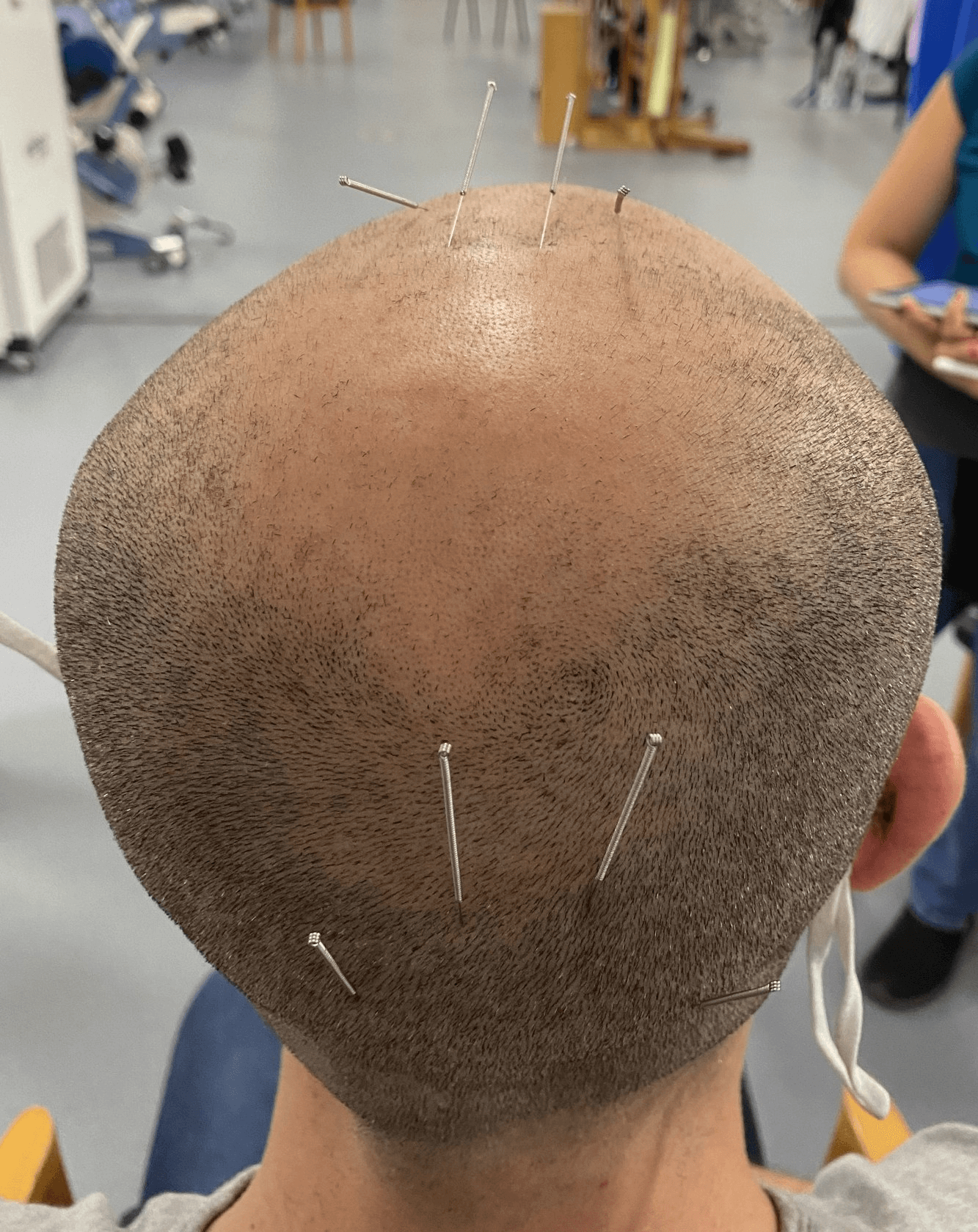
Prescription and Treatment Process: Acupuncture points included the scalp acupuncture Central area , the Foot motor-sensory area, Balance area, Mania control area, Fengfu (DU-16), Fengchi (GB-20), Dazhui (DU-14), Lieque (LU-7), and Houxi (SI3), etc. The needles were rapidly rotated and retained for 20 minutes. Treatment was administered weekly for three weeks, then reduced to once every two to three weeks. After the first treatment, the patient reported some relief from spasms; by the third treatment, about half of the spasms had subsided. Treatment was stopped for three weeks due to family reasons, resulting in some relapse. Significant improvement was observed for one week after the fifth treatment, but again, after a three-week break for the Christmas and New Year holidays, or other breaks, the improvement returned to 10%-20%. Treatment is currently ongoing.